

What to Expect as a Social Worker: 7 Career Realities & Survival Strategies
Stepping out of an academic program and entering the human services field is a transformative milestone. While social work education equips you with core theoretical models, the day-to-day realities of frontline practice often look significantly different than what textbooks describe.

Drawing from over 12 years of clinical social work experience shared by top therapist, alongside institutional insights from professional governing bodies, here is a breakdown of seven foundational realities every aspiring practitioner should prepare for—and how to navigate them effectively.
|
Core Reality |
What You Expect in School |
Field Reality |
Key Action Strategy |
|---|---|---|---|
|
Schedule |
Standard 9-to-5 office hours |
Flexible, evening, or shift work |
Establish clear working hours and calendar boundaries early. |
|
Documentation |
Universal digital systems |
Antiquated software or paper filing |
Streamline note-taking workflows (e.g., SOAP/DAP templates). |
|
Problem Solving |
Direct intervention & answers |
Resource coordination & co-creation |
Shift from fixing to empowering clients in case planning. |
|
Emotional Load |
Manageable empathy |
Secondary traumatic stress risk |
Identify personal triggers and build peer support networks. |
|
Bureaucracy |
Policy as a background concept |
Systemic red tape & politics |
Practice active micro- and macro-level advocacy. |
|
Client Progress |
Immediate, visible outcomes |
Small, non-linear incremental gains |
Redefine personal metrics for “making a difference”. |
|
Career Longevity |
High passion carries you |
Burnout if staying in bad fits |
Engage in ongoing skills training and role evaluation. |
1. Non-Traditional Hours Are Standard Practice
Meeting vulnerable populations where they are rarely fits inside a rigid 9-to-5 framework. Whether working in community mental health, hospital crisis units, child protective services, or private practice, client availability dictates schedules.
Therapists in outpatient settings, for example, frequently extend appointments into the evening to accommodate working adults and school schedules. Hospital and emergency settings demand round-the-clock shift rotations.
Practitioner Tip: Rather than viewing non-traditional hours as an imposition, build structured flex-time into your week to protect your personal energy and avoid chronic exhaustion.
2. Paperwork and Systems Disconnects Will Test Your Patience
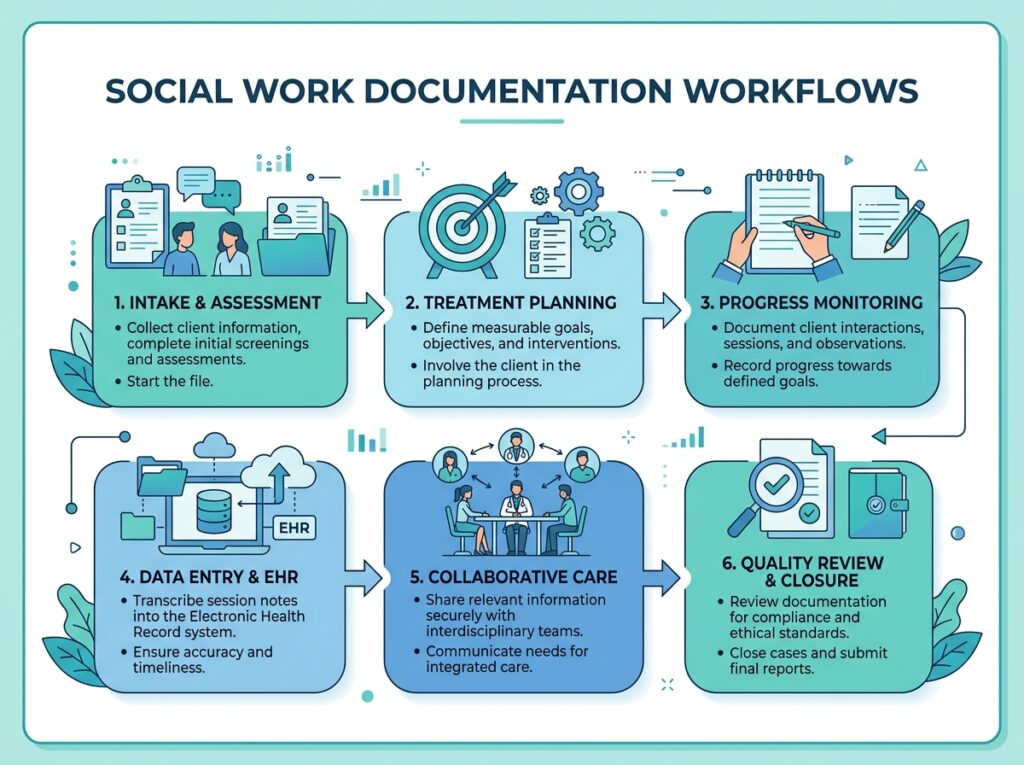
While social work programs teach documentation formats like SOAP (Subjective, Objective, Assessment, Plan) and DAP (Data, Assessment, Plan) notes, they rarely prepare you for the technological fragmentation found in agencies.
[Academic Theory] ──> Standardized SOAP/DAP Notes
[Field Practice]   ──> Hand-written files + Multi-software entry + Outdated compliance policies
Many community organizations still operate with paper files or use disparate software applications that do not communicate with one another. Re-entering identical information across multiple platforms is a frequent operational frustration. Streamlining your administrative process early is vital to prevent documentation backlogs.
For social workers interested in refining their clinical documentation and operational management skills, exploring professional development courses and training modules provides structured guidance on managing caseloads efficiently.
3. Your Role Is Collaborative Problem-Solving, Not “Fixing”
A common mistake for incoming practitioners is assuming the burden of solving a client’s problems for them. Sustainable change happens when you shift from a directive approach to a collaborative partnership.
Effective Problem-Solving Framework
- Resource Verification: Before referring clients to external programs, verify availability directly via collateral calls to ensure services remain active and affordable.
- Co-Created Case Plans: Engage clients directly in setting goals rather than handing down pre-made mandates.
- Empowerment Questioning: Ask open-ended questions that encourage self-reflection:
- “What do you think about incorporating this step into your goals?”
- “How do you feel this option supports where you want to be?”
- “What triggers have you noticed when dealing with anger in the past?”
4. Secondary Traumatic Stress Requires Proactive Management
Working daily with traumatized individuals, domestic violence survivors, or families facing acute instability carries an emotional tax. Social workers frequently absorb secondary trauma, particularly if a client’s lived experience overlaps with the practitioner’s personal history.
To protect your well-being, reference guidelines established by the National Association of Social Workers (NASW) Code of Ethics, which emphasizes self-care as a professional duty. Additionally, consulting public mental health resources through organizations like the Substance Abuse and Mental Health Services Administration (SAMHSA) can help you identify specialized tools for managing workplace burnout.
5. Navigating Institutional Red Tape and Policy Realities
Every agency operates under local, state, and federal regulations that influence client service delivery. Political climates, funding shifts, and bureaucratic agency rules often create barriers for the very individuals you are trying to serve.
- Expect Systemic Roadblocks: Policy decisions do not always prioritize the immediate needs of vulnerable communities.
- Exercise Active Advocacy: Expecting red tape does not mean accepting it passively. Advocacy is a fundamental pillar of social work practice. Question outdated policies, present solution-oriented alternatives to administrators, and advocate for policy reform on behalf of your clients.
6. Success Is Measured in Small, Incremental Steps
Many social workers enter the field seeking dramatic, systemic transformations. Real-world change, however, is often quiet, non-linear, and delayed.
Client Progress Trajectory:
[Trauma / Adaptive Behaviors] ──> [Awareness] ──> [Incremental Growth] ──> [Long-Term Breakthrough]
A client may not change their circumstances overnight. Success might look like a parent adopting a single new communication technique, or a survivor growing more aware of their personal worth. You may not always be present to witness the final outcome of the seeds you plant, but those micro-advancements form the foundation for lasting growth.
7. Staying Too Long in a Bad Fit Impairs Your Impact
When practitioners feel stuck in an agency that lacks support or alignment, staying indefinitely can lead to resentment and severe burnout. Evaluating your position, continuing your education, and transitioning into new areas of practice—such as private clinical work or administrative leadership—is often necessary to sustain a long and fulfilling career.
Frequently Asked Questions
The primary challenges include high paperwork volumes, navigating outdated or disconnected software systems, managing non-traditional work hours, and coping with secondary traumatic stress.
Preventing burnout requires setting firm calendar boundaries, establishing professional peer support, engaging in regular clinical supervision, maintaining personal self-care practices, and utilizing stress-reduction strategies.
SOAP notes divide documentation into Subjective, Objective, Assessment, and Plan components. DAP notes combine subjective and objective data into a single Data section, followed by Assessment and Plan. Both are standard formats used to track client progress and satisfy agency compliance.